# Taste Is Caught, Not Taught
> 📖 本站完整內容索引(documentation index):[llms.txt](/llms.txt)
> 作者:easyvibecoding · 發佈:2026-06-22
> This is the English companion to a Traditional Chinese essay. Some quotations are given in their original English; the argument is the same.
At the end of the previous essay, [Abstract System Engineering](/blog/abstract-system-engineering-en), we climbed an abstraction ladder that pulls humans out of the loop one rung at a time, and stopped at the one square the machine can't yet cross: the person who defines what "good" means. That essay landed on a single word—taste. A machine can climb high and fast, but as long as the "good" above its head is fuzzy and can't be cheaply verified, it still needs a human standing outside the loop to say: *this* one counts.
That essay stopped at "taste is the last square humans hold," but left a harder question unanswered: this taste we're betting everything on—what is it, exactly? Is it an innate gift, or something you can train? And if you can train it, how?
As it happens, around the same time, in February 2026, the whole tech industry started arguing about the same word.
It started with Paul Graham, who on February 14 posted a prediction on X: "When anyone can make anything, the big differentiator is what you choose to make." Two days later OpenAI's president Greg Brockman put it more bluntly: "Taste is a new core skill." Even Cloudflare's CTO Dane Knecht piled on: "Building is easy now. Knowing what to build, and what not to, is the hard part."
But it wasn't all praise. Linear's Nan Yu shot back coldly: "you probably don't have better taste than AI." Others questioned what made anyone think taste was a uniquely human ability at all.
Why are engineers suddenly arguing about taste? Because something is happening: when generation becomes nearly free, value shifts from "being able to make it" to "being able to judge which one is good." As one essay put it bluntly—in 2026, "creating" is a commodity, a utility, like tap water or electricity; and when creation is cheap, value shifts to curation. So the thing that was always treated as mysticism, as "you'll just know when you've done it long enough," suddenly became a valuable—and unavoidable—question: what is taste, can it be trained, and how?
## 1. Taste is the ability to judge direction—not surface polish
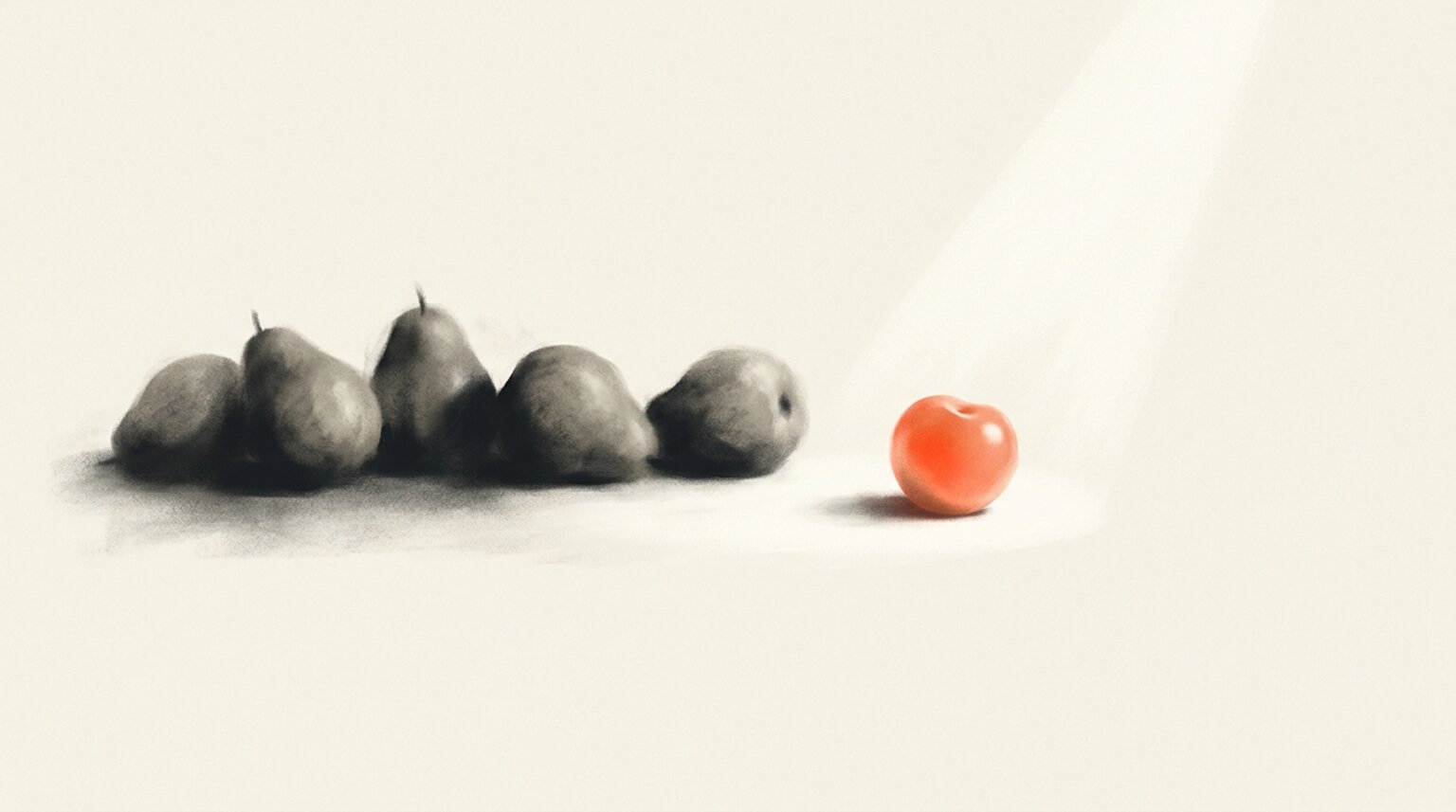
Taste: picking the one that's right, at a glance.
You can't talk about this without one person.
In the 1995 interview later released as *The Lost Interview*, Steve Jobs said something cutting: "The only problem with Microsoft is they just have no taste. They have absolutely no taste." He went on to explain what "no taste" meant—not that the interface was ugly, but that "they don't think of original ideas, and they don't bring much culture into their product."
Notice the definition: taste isn't surface prettiness; it's **whether you have the judgment to bring the right things in**. In the same interview he put it more fully:
> You know, ultimately it comes down to taste. It comes down to trying to expose yourself to the best things that humans have done. And then try to bring those things in to what you're doing.
He added a now-overused line with a tangled provenance: "Picasso had a saying, he said: good artists copy, great artists steal," admitting "we have always been shameless about stealing great ideas." (There's no solid evidence Picasso actually said it; the earlier source is T. S. Eliot. But Jobs's framing—he was *quoting* it—points right at the heart of taste, which we'll come back to.)
Jobs tied taste to something more fundamental: breadth of experience. In a 1996 *Wired* interview he said creativity is really just "connecting things"—and his critique of his own industry was that "a lot of people in our industry haven't had very diverse experiences. So they don't have enough dots to connect, and they end up with very linear solutions without a broad perspective on the problem." And in that earlier 1995 interview he made the same point another way: the Macintosh was great because the people who made it "were musicians and poets and artists and zoologists, and historians, who also happened to be the best computer scientists in the world." The raw material of taste is breadth.
This isn't just Jobs's idiosyncrasy. The people who pushed design to its limit say almost the same thing in different words—**taste is subtraction, subtracting down to the essential.** Dieter Rams's tenth principle of good design: "Good design is as little design as possible. Less, but better." Jony Ive warns against the obvious misreading: "Simplicity is not the absence of clutter"—a lack of clutter is just a consequence, not simplicity itself. John Maeda compresses it to one line: "Simplicity is about subtracting the obvious, and adding the meaningful."
Put them together and the shape of taste comes clear: it isn't an aesthetic preference about "looking nice." It's a **judgment about what the right direction is, about what to keep and what to cut.** It's close to discernment—seeing good from bad at a glance, in a way that holds up to people with even better eyes.
## 2. Why it's always "hard to put into words"
Some knowing can be grasped, but never quite told.
But the moment you press someone with taste—"how do you know this one is better?"—you hit the same wall: they can't quite say.
That's not them being secretive; it's the nature of this kind of knowledge. In 1966, the philosopher Michael Polanyi gave it a precise name in *The Tacit Dimension*: "We can know more than we can tell." He called it **tacit knowledge**: you can pick one face out of a thousand, yet can't explain *how* you recognized it.
This idea isn't foreign to any culture. English already gestures at it—"I know it when I see it," "I can't put it into words." Chinese bakes it straight into idiom: 只可意會,不可言傳 ("it can be grasped in the mind but not conveyed in words"). What they all point at is the same thing: a knowing that's perfectly clear inside you and won't line up into words coming out. Researchers of tacit knowledge like Harry Collins note that this kind of knowledge passes mainly through direct contact and immersion—it's hard to hand off through documents or rules.
This is taste's most awkward—and most important—property: it's real, it has a hierarchy of better and worse, you can judge with it, and yet it **resists being written down as a method.** That's why all those "ten laws of design" and "taste in five easy steps" can only approximate it; they can't replace it.
This is usually where the discussion stops—a quick "taste is mysticism, it's a gift" and the question is closed. But that's exactly the conclusion most worth overturning. That taste is hard to articulate doesn't mean it can't be learned. There is a path. It just isn't a formula; it's a loop.
## 3. How to cross the threshold
Crossing the threshold: from following the rules to knowing at a glance.
Take everyone above and pull their experience apart, and you find they're describing the same training loop. I've laid it out as five steps—and this is the part this essay actually wants to leave you with.
**Step 1: Care first. Deliberately cultivate the taste of your field.** Paul Graham puts it most directly in "How to Do Great Work": "Consciously cultivate your taste in the work done in your field. Until you know which is the best and what makes it so, you don't know what you're aiming for." Taste is the ruler; without it, you can't even tell whether your own work is any good. So step one isn't a technique—it's **beginning to genuinely care about the difference between good and bad**, being willing to sweat the small "rightness."
**Step 2: Immerse in "the best things humans have done," and build yourself a library of gold-standard examples.** This is the practical version of Jobs's "expose yourself to the best things that humans have done." Your eye is fed by what you steep in. Austin Kleon says it plainly in *Steal Like an Artist*: "You're only going to be as good as the stuff you surround yourself with." Garbage in, garbage out. So deliberately go look at the best—the best code, the best writing, the best products—and look at *enough* of it, *varied* enough, because the raw material of taste is breadth (only then do you have enough dots to connect).
**Step 3: Accept that your taste runs ahead of your skill—then close the gap with volume.** This is the most painful stretch of the path, and the one most worth saying out loud. Ira Glass described it in words that are almost every creator's shared experience:
> All of us who do creative work, we get into it because we have good taste. But there is this gap. … your taste, the thing that got you into the game, is still killer. … It is only by going through a volume of work that you will close that gap.
The beginner's agony was never a lack of taste—it's that **the taste is already good enough and the hands haven't caught up.** The fix isn't romantic, and it isn't waiting for inspiration: it's volume.
**Step 4: Put your work next to the best, get feedback, and hammer the weak spots—deliberate practice.** Sheer volume isn't enough on its own; it produces competent mediocrity. Studying top performers, the psychologist Anders Ericsson found that what sets "deliberate practice" apart from ordinary practice is feedback—you need a setup that keeps showing you where you fall short, where the gap to the gold standard is, and then you go attack that specific weakness. Honestly set your work next to the best in your example library, and the gap declares itself. And the judge making that comparison is, from start to finish, your own developing eye—not any machine scorer; it's exactly the out-of-loop verifier, the one machines can't reach, that the companion essay is about.
**Step 5: Eventually the rules sink below the surface and become intuition—that's the moment you cross the threshold.** The Dreyfus brothers' model of skill acquisition maps this path: novice, advanced beginner, competent, proficient, expert. They note specifically that the intuitive perspective—a direct sense of what's relevant and called for in a situation—emerges at the fourth and fifth stages. A novice can only push through the rules one at a time; an expert no longer thinks about the rules, because they've been internalized into the body. The operational definition of taste crossing the threshold is exactly this shift: **from "following the rules" to "knowing at a glance whether it's right."**
String the five together and you get a loop: **care → immerse in the gold standard → produce in volume → compare and get feedback → internalize into intuition**—then run it again with a sharper eye.
There's one last piece, back to that line Jobs quoted: "great artists steal." It often gets used to excuse plagiarism, but the original meaning is the opposite. The fuller source is T. S. Eliot, 1920: "Immature poets imitate; mature poets steal; bad poets deface what they take, and good poets make it into something better, or at least something different." *Make what you took into something better, or at least something different*—that is the operational definition of taste. It isn't copying; it's **transformation with judgment.** And that takes us right back to the 2026 argument.
## 4. The AI-era bet, and an honest counterargument
If the essence of taste is "transformation with judgment," then the real question becomes: when AI turns "production" into tap water, who does the judging?
Andrej Karpathy made this concrete at a Sequoia event in April 2026. He drew up a list of what's getting cheap and what's getting scarce: cheap is code generation, boilerplate, first drafts, repetitive setup; scarce is "understanding, taste, eval design, security, system boundaries … and knowing when the model is off the rails." His analogy: agents right now are like interns—"You still have to be in charge of aesthetics, judgment, taste, and oversight."
That's the bet: when anyone can generate anything, the difference retreats to the person who can judge which one is good. Everything in this essay about "taste resists being written as a method" gains real weight here—precisely because taste is the kind of judgment hardest to rule-ify and hardest to automate, it's the thing that floats *up* in an automation wave. That wall that can't quite say what "good" is, is the flip side of the "verifiability" wall I wrote about in [Abstract System Engineering](/blog/abstract-system-engineering-en): what can be clearly verified, machines will eventually take; what can't, is left to people.
But here we have to plant an honest counterargument, or this becomes self-soothing.
The first counter comes from the data. A 2026 study (WritingPreferenceBench) did something clever: it gathered 1,800 human-annotated writing-preference pairs, then **controlled out objective correctness, facts, and length**, leaving only pure subjective quality—creativity, stylistic flair, emotional resonance—and checked whether AI reward models could catch it. The result: the standard RLHF reward model scored just 52.7%, barely better than a coin flip. Its conclusion was blunt: "current RLHF methods primarily learn to detect objective errors rather than capture subjective quality preferences." In other words, on "is it correct" AI is strong; on "is it good," it's still standing outside the threshold.
But the same study has a second half worth chewing on: when the model was asked to **produce a reasoning chain**—to explain *why* it judged one piece better—accuracy jumped to 81.8%. What can "say why" catches part of subjective quality; what can only "match and score" does not.
The second counter comes from the engineer Shrivu Shankar. In "Taste Is Not a Moat" he poured cold water: a moat is something you build once and defend, but "Taste feels more like alpha: a decaying edge, only valuable relative to a rising baseline." His point: AI's baseline keeps climbing, absorbing your taste advantage bit by bit. It's a warning worth taking seriously: taste will be worth more in the AI era, but it may not be a one-and-done moat—more likely a lead you have to keep re-earning.
The dots only connect looking backward.
## Conclusion: caught, not taught
Lay three things side by side and you find they're three mirrors of the same thing. AI's RLHF can only match and score and can't say why, so it can't catch subjective quality; the novice in the Dreyfus model can only follow rules and can't yet articulate the intuition; Polanyi says pure tacit knowledge is the hardest to formalize—we can know more than we can tell. All three point at the same marker: being able to "say why it's good" is often an **outward signal** that taste has crossed the threshold. This doesn't mean mature taste keeps reciting rules out loud—on the contrary, by then the rules have long since sunk into silent intuition; it means that when pressed, such a person can retroactively translate **part** of that intuition back into words, while a novice—and an RLHF model that only matches and scores—can't yet do even that.
And that answers the argument we opened with. Taste isn't an innate gift of mysticism; it has a clear training loop: care, immerse in the gold standard, produce in volume, compare and get feedback, internalize into intuition. In that sense, it **can be learned.** But it has no copy-paste formula, no ten quick rules that walk the road for you—in that sense, it **can't be taught.** Taste is the kind of thing that can only be caught, never handed over.
In his 2005 Stanford address, Jobs said the calligraphy class he dropped in on—useless at the time—only connected up years later, when he was building the Macintosh: "you can't connect the dots looking forward. You can only connect them looking backwards." Taste is like that. Every good thing you steep in seems useless at the moment, until one day they connect, in your hands, into a judgment that sees at a glance whether something is right.
At that moment, no one can hand it to you. You can only grow it yourself.
---
### Glossary
- **Tacit knowledge**: the kind of knowing where we can know more than we can tell—passed through direct contact and immersion, hard to write into rules. Coined by Michael Polanyi (1966); the Chinese idiom 只可意會,不可言傳 is the same idea.
- **Deliberate practice**: practice built around immediate feedback and attacking specific weaknesses, from Anders Ericsson's studies of top performers; the key is feedback, not mere repetition.
- **Dreyfus skill-acquisition model**: novice → advanced beginner → competent → proficient → expert; the intuitive perspective emerges at stages four and five—the threshold from "following rules" to "knowing at a glance."
- **RLHF (reinforcement learning from human feedback)**: the mainstream way of training AI on human preferences. Research shows it's good at catching "objective errors" but weaker at "subjective quality" like creativity and flair.
- **Decaying alpha**: Shrivu Shankar's metaphor for taste—relative to AI's ever-rising baseline, taste is a lead that gets absorbed and must be re-earned, not a permanent moat.
- **WritingPreferenceBench**: a 2026 benchmark for subjective writing preference (arXiv 2510.14616); after controlling for objective correctness, a standard RLHF model judges subjective quality at only ~52.7%.
### Related
- [Abstract System Engineering: When the Loop Starts Rewriting Itself](/blog/abstract-system-engineering-en)—the other side of this essay's "what counts as good, and why machines can't catch it": the wall called verifiability.
### Sources
Principal references (all verified):
- Steve Jobs: the 1995 *Triumph of the Nerds* interview ("no taste," "it comes down to taste," "good artists steal"), the 1996 *Wired* interview "The Next Insanely Great Thing" (connecting things / dots), and the 2005 Stanford commencement (the calligraphy class / connect the dots backwards)
- Dieter Rams (Ten Principles of Good Design), Jony Ive, John Maeda (*The Laws of Simplicity*), Don Norman (*Emotional Design*), Austin Kleon (*Steal Like an Artist*)
- Michael Polanyi, *The Tacit Dimension* (1966); Harry Collins, *Tacit and Explicit Knowledge* (2010)
- Paul Graham, "How to Do Great Work" and "Taste for Makers"; Ira Glass (This American Life); the Dreyfus brothers' five-stage skill model; T. S. Eliot, *The Sacred Wood* (1920)
- The 2026 AI debate: Paul Graham (2026-02-14), Greg Brockman (2026-02-16), Dane Knecht (Cloudflare, via media), Nan Yu (Linear); Andrej Karpathy (Sequoia AI Ascent 2026); Shrivu Shankar, "Taste Is Not a Moat"; Eric M. De Castro, "Taste is the Only Moat: Surviving the AI Flood" (Medium, 2026)
- WritingPreferenceBench (arXiv 2510.14616)
Note: this is original commentary and synthesis; quotations are attributed. "Good artists copy, great artists steal" is Jobs paraphrasing—not Picasso's own words (the earlier source is T. S. Eliot); WritingPreferenceBench's 52.7% refers to subjective-quality judgment "after controlling for objective correctness, facts, and length."